
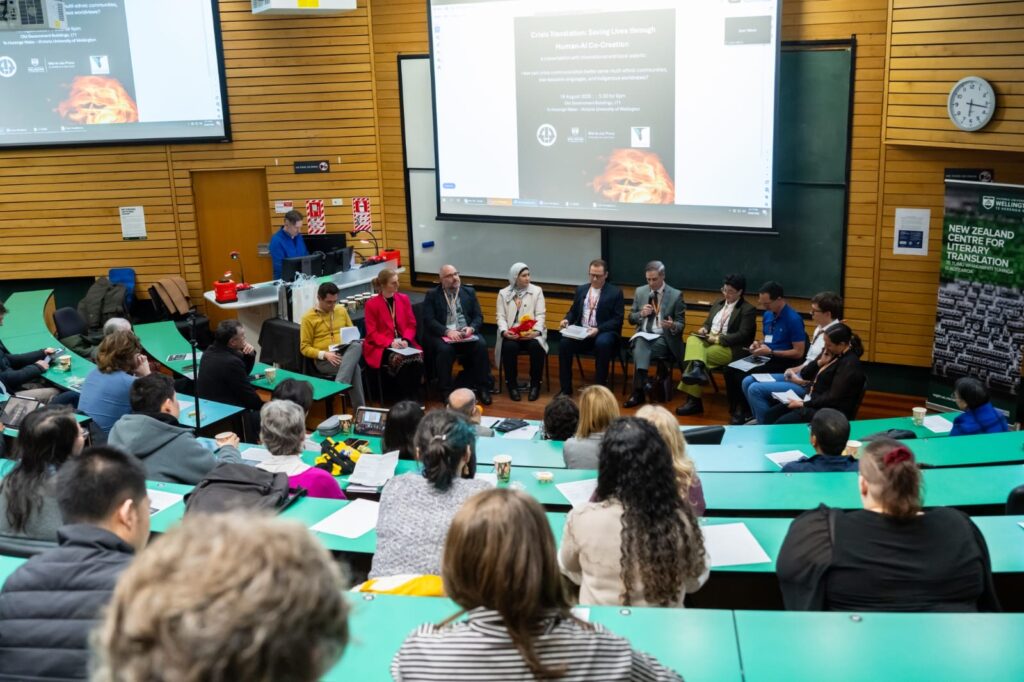
From left to right: Dr Fahim Afarinasadi (MSD), Dr Sara Harrison (Hazard and Risk Social Scientist, NZ), Prof Federico Federici (University College London), Dr Roula Salam (FIT, University of Alberta), His Excellency Keith Smith, Agustina Marianacci (NZSTI), Peter-Lucas Jones (Te Hiku Media), Dr Mark Fishel (University of Tartu), Te Ataahia Hurihanganui (Te Reo Māori translator and educator).
Photo: Colin McDiarmid, Visual Communicator at Te Herenga Waka, Victoria University of Wellington.
By Roula Salam
(FIT Vice President and Chair of FIT Crisis Settings Standing Committee)
In September 2023, a retired Canadian Armed Forces major spoke at the Association of Translators and Interpreters of Alberta (ATIA) on International Translation Day. She used the Dari phrase shona ba shona (‘shoulder to shoulder’) to describe working with interpreters in Afghanistan – a tribute to those risking their lives for NATO soldiers. While language support in high-stakes settings saves lives, true readiness demands preparation. When communication networks fail, translators, interpreters, specialists and technology keep information accurate, timely and respectful.
From 18- 20 August, a global delegation gathered at Te Herenga Waka, Victoria University of Wellington, invited by Professor Marco Sonzogni and his research team to discuss a human-centred, AI-supported approach. Co-hosted by FIT and the New Zealand Society of Translators and Interpreters (NZSTI), alongside the Canadian High Commission and the Embassies of Argentina, Estonia and Italy, the event aimed to explore crisis translation and share lessons from past crises.
Panellists included community leaders and experts in language mediation, media, earth sciences and technology. Indigenous narratives blended with the lived experiences of first responders and advocates for vulnerable groups, driving an approach rooted in social justice, epistemic equity and responsible technology use. The opening evening began with a mihi (‘greeting’) led by Māori scholar Mike Ross, Head of Te Kawa a Māui. Mr Keith Smith, High Commissioner for Canada, introduced the event, moderated by Antonio Viselli. Panellists included Fahim Afarinasadi, Federico Federici, Mark Fišel, Sara Harrison, Te Ataahia Hurihanganui, Peter-Lucas Jones, Agustina Marianacci and myself.
The second day featured a brainstorming session on training programmes, the impact of journalism and public relations in a crisis, and the possibilities and limitations of Large versus Small Language Models and AI tools. Federico Federici shared field research from crisis zones, while Mark Fišel discussed his work with European Sámi languages. I presented on FIT’s role and work, the Canadian wildfire displacement of Indigenous and vulnerable communities, and the University of Alberta’s commitment to advancing reconciliation and Indigenous knowledge, cultures and ways of knowing in education and AI integration. We discussed what true collaboration with Indigenous and minority communities means for social justice, and identified vulnerable languages threatened by unguided use of AI.
On the final day, panellists reconvened with Marco Sonzogni and Sydney Shep to map out funding and next steps. This event launches a long-term project reliant on the FIT community’s collective efforts. We will soon contact our Regional Centres to collaborate on resource mapping, crisis training and emergency communication strategies.
My heartfelt gratitude to Marco Sonzogni for organising this event, and to High Commissioner Keith Smith for honouring me and my husband, Warrant Officer Ibrahim Baghdadi, during our stay in Te Whanganui-a-Tara.