
By Lee Yacoumis, Strategic Engagement Manager (NAATI)
In 2026, the National Accreditation Authority for Translators and Interpreters (NAATI) will deliver its first national consumer awareness campaign – an ambitious, multilingual initiative focused on strengthening the role of certified interpreters in Australia’s health system.
NAATI’s Certification System underpins the quality and integrity of Australia’s translator and interpreter workforce. Through rigorous testing, professional standards and a binding code of ethics, NAATI certification assures that practitioners are competent to support accurate, impartial and culturally responsive communication. Nowhere is this more critical than in healthcare.
In clinical settings, certified interpreters enable informed consent, reduce clinical risk, and support clear communication between patients and providers. Yet despite national and state policies that mandate or recommend professional interpreters, uptake remains inconsistent. Too often, family members, bilingual staff or ad hoc arrangements are used – compromising safety, privacy and quality of care.
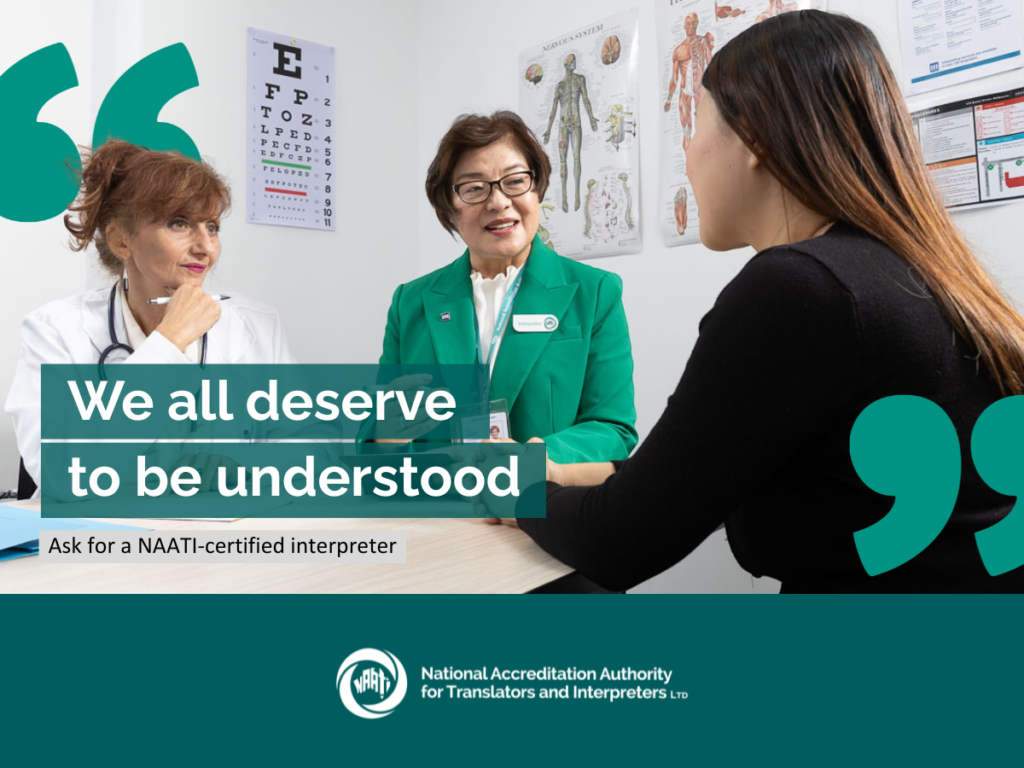
NAATI’s 2026 campaign, ‘We all deserve to be understood’, seeks to address this gap.
Delivered in partnership with SBS In Language and CulturalPulse, the campaign will reach communities through multilingual television, radio and out-of-home advertising, alongside grassroots engagement. Its purpose is twofold: to empower communities to request certified interpreters and to encourage health professionals – particularly GPs – to engage qualified practitioners as standard practice.
The campaign targets speakers of 17 languages other than English and is supported by a multilingual website. At its centre is an enhanced version of NAATI’s online directory, making it easier for consumers and clinicians to find certified translators and interpreters across Australia.
This initiative also holds relevance internationally. Member associations may find value in the 13 practical resources developed for the campaign. All resources are available in 18 languages. While tailored to the Australian context, the principles underpinning them – professional standards, role clarity, preparation and ethical practice – are universal.
These plain-language guides support better engagement with language professionals:
- How to work with an interpreter – for service providers, outlining practical steps before, during and after an interpreted session.
- Preparing for an interpreter appointment or meeting – a consumer resource explaining what to expect and how to participate effectively.
- How to prepare your document for translation – guidance for individuals and organisations seeking accurate translation outcomes.
For associations globally, these materials may serve as adaptable templates for local awareness campaigns, educational tools for members and service users, or advocacy assets in discussions with policymakers and healthcare stakeholders. They demonstrate how a national credentialling authority can extend beyond regulation into public education, supporting consumers with understanding how our sector works.
As health systems worldwide respond to increasing linguistic diversity, collaborative initiatives such as this offer a practical model for strengthening awareness, trust and best practice across borders.
Find the resources and the new directory at https://directory.naati.com.au/.
Photo credit: https://www.casamentophotography.com.au/