
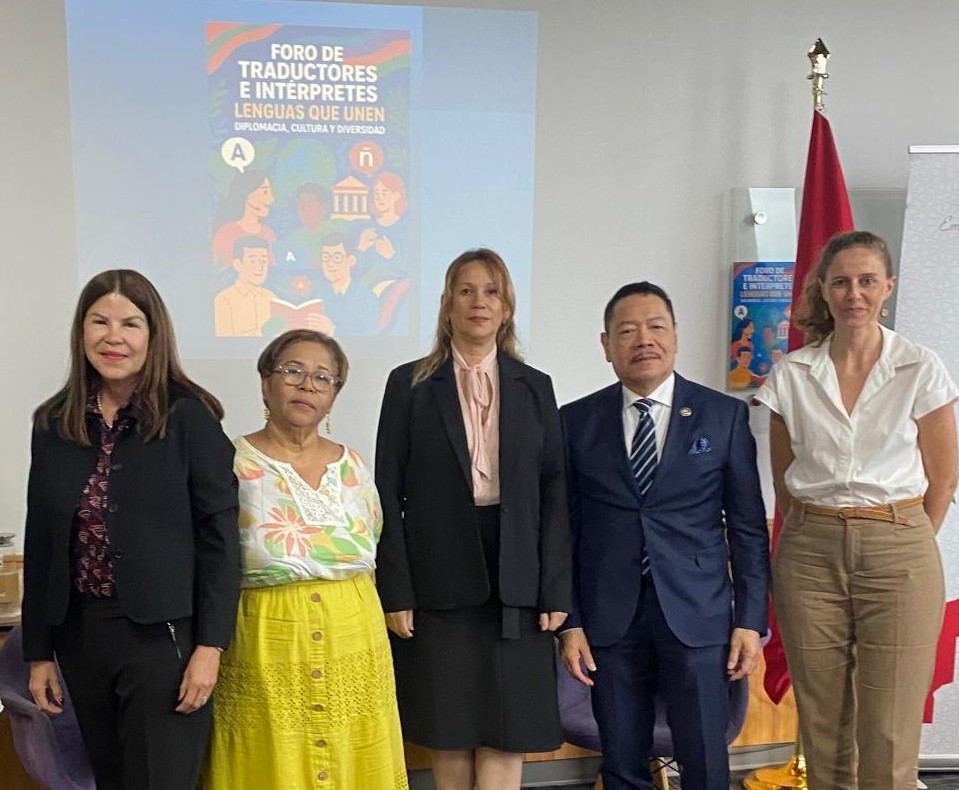
The Translators and Interpreters Forum ‘Languages that Connect: Diplomacy, Culture, and Diversity,’ held on 30 September 2025 in the conference hall of the Asociación Panameña de Traductores e Intérpretes (APTI), offered an opportunity to reflect on the role of language in contemporary diplomacy and in building intercultural bridges.
The event brought together prominent personalities from the diplomatic, academic, and cultural spheres, all of whom agreed that language, in all its forms, is a core element of identity and a vital tool for global understanding.
Professor Irina Nemtchénok de Ardila, full member of the Panamanian Academy of Language, opened the conference series with a presentation entitled ‘Language as a Key to National Identity and its Role in Global Diplomacy’, highlighting language as a vehicle for collective memory and mutual respect among cultures.
Deputy Foreign Minister Alejandro Mendoza followed with his talk on ‘The Importance of Translators and Interpreters in International Diplomacy and Foreign Affairs’, emphasising that behind every document, agreement, or treaty stands a language professional ensuring accuracy, neutrality, and trust between parties.
Katharine Felton, Deputy Head of Mission and Consul at the British Embassy in Panama, spoke about the strategic value of languages as tools for effective communication and multilateral cooperation.
From the cultural sector, Pauline Villemagne, Director of the Alliance Française in Panama, shared her institution’s experience promoting multilingualism as a means of cultural diplomacy capable of connecting diverse communities.
Liza Romina Pinzón, President of the National Association of Career Diplomats of Panama (CONADIP), explored ‘Languages and Diplomacy: Strategies for Intercultural Communication in the 21st Century’, underscoring the importance of cultural intelligence as a key diplomatic skill.
Finally, Isabel Cubilla, Director of the Translation Program at Universidad Latina de Panamá, noted that training translators and interpreters goes beyond technical expertise: it requires an ethical commitment to accuracy, inclusion, and mutual understanding.
The forum closed with a networking session, reaffirming the central message: languages are the foundation of genuine diplomacy and the most powerful tool for dialogue among nations.
Reina de Bettendorf, APTI