
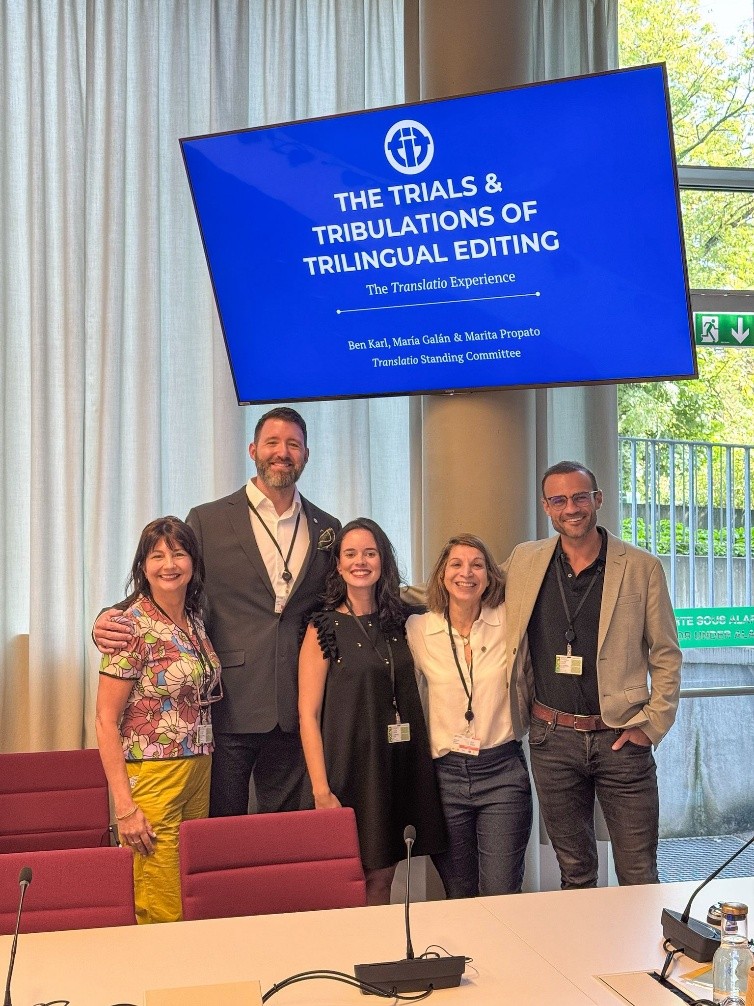
During the XXIII World Congress, three members of the Translatio team that diligently produces this humble newsletter together every quarter (Ben Karl, Chair of the Translatio Standing Committee, Marita Propato, Spanish Language Lead, and María Galán, Spanish Language Project Manager) gave a panel to share their experiences working on one of FIT’s flagship publications. The interactive and conversational session at WIPO headquarters was the perfect opportunity for the standing committee members to pull back the curtain, share the trials and tribulations of trilingual editing, the highs and lows from the mandate, and what they’ve accomplished over the past three years.
In addition to introducing attendees to the committee’s dedicated volunteers and their roles, the panellists also talked nuts and bolts: how it defines the publication schedule, where it sources articles and how it manages quality throughout the trilingual copyediting and translation processes, the creation of reference materials, terminology management, publishing and promoting articles, and providing feedback to everyone involved. It truly is no small feat.
Among the trials and tribulations: adding a new language to the mix when FIT adopted a third official language in Varadero in 2022. This included a meaningful overhaul to the committee’s process, building on what the chair, Ben Karl, had learned during the previous mandate, including making a reliable vendor pool, creating stylistic guidelines, and ensuring proper representation of different varieties of Spanish. The team also implemented an initiative to adopt gender-neutral language, a unique challenge with two highly gendered languages, Spanish and French. And perhaps most importantly – and visibly – the team migrated from static PDFs distributed primarily by email to the modern, sharable blog format you’re reading right now. This major change has made Translatio more accessible, easier to read and search, and easier to repost, giving member associations greater visibility.
Throughout these changes, the standing committee has worked to maintain consistency, tone, and terminology, and to remain true to the publication’s core purpose: to serve as a key medium of internal (and increasingly, external) communications for FIT. While many of these initiatives came with healthy initial doses of frustration, even growing pains, they also allowed the team to evolve, learn, and make Translatio even better. Today, the fruits of the committee’s labour are easy to appreciate!
If you, dear readers, are interested in helping to steer Translatio into the future, ask your professional association to nominate you to serve on the Translatio Standing Committee. Whatever your talents, the committee will be able to put them to good use.
Marita Propato and Ben Karl, Translatio Standing Committee